
Solidarity Syllabus: Honoring Alice Wong
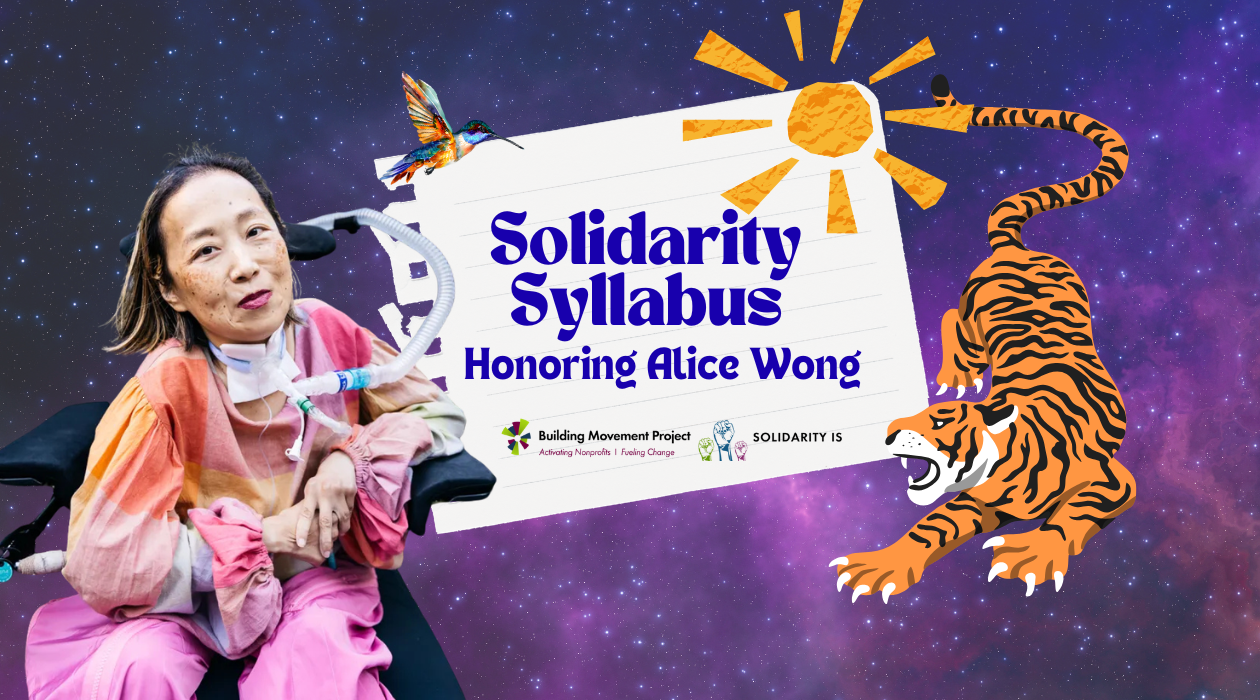
Digital collage of Alice Wong, an Asian American woman in a wheelchair with a tracheostomy at her neck connected to a ventilator. She’s wearing a pink plaid shirt, pink pants, and a magenta lip color. She is smiling. The backdrop is a photo of a star field with shades of pink and purple. There is an illustration of a colorful hummingbird, a fierce tiger, and a sunburst. The blue text on a sheet of notebook paper reads: Solidarity Syllabus - Honoring Alice Wong.
This Solidarity Syllabus is an invitation to begin or deepen learning about the life and work of Alice Wong, a disabled activist, writer, editor, and community organizer.
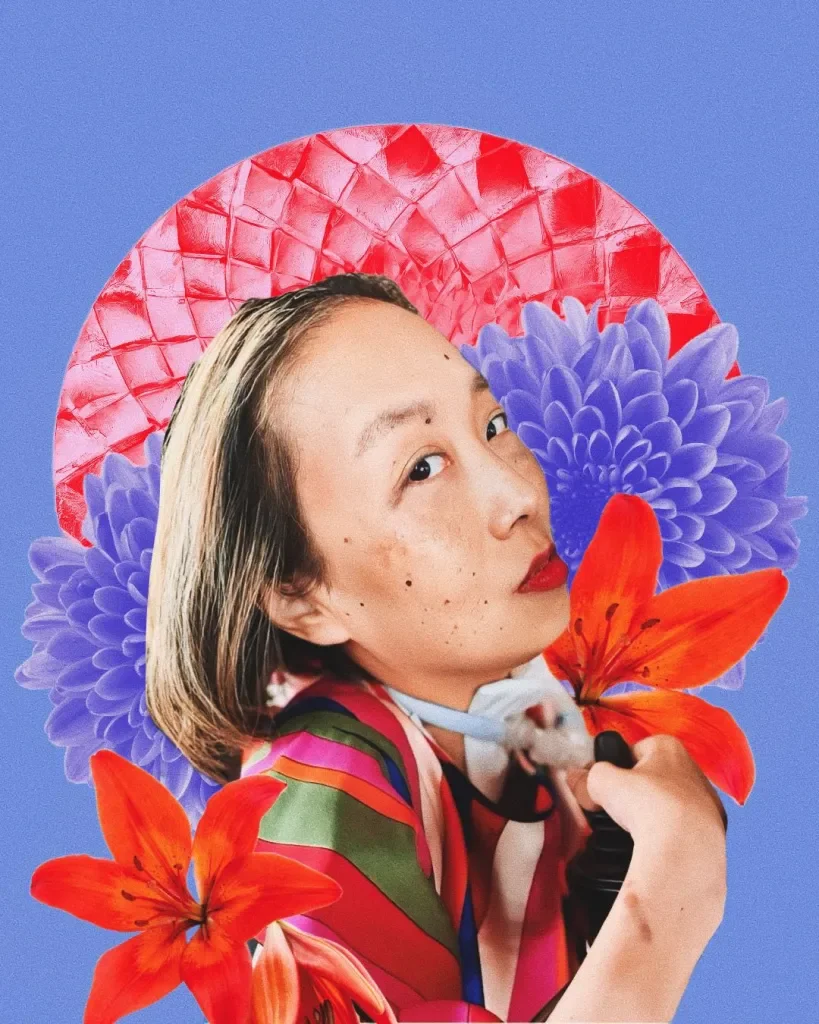
Digital portrait by Jen White-Johnson featuring a photo of Asian American woman with honey blonde hair. She is in a wheelchair and there is a tracheostomy at her neck connected to a ventilator. She is wearing a silky multicolored shirt and a bold red lip color. She is looking intently at the camera with the heat of a thousand suns. Behind her are red and purple flowers with a red circle in the background framing her face like a warm sun. The background of the portrait is purple. Photo and description via the DisabilityVisibilityProject.org media kit.
Alice became an ancestor on November 14, 2025. In March 2026, a Celebration of Life was held in her honor, and a community toolkit was shared with ideas of ways to honor Alice’s many legacies. One idea was to share stories: “Alice was/is a lifelong storyteller, not just of her own life, but she made sure thousands of people’s stories were told and amplified.”
Here, we share a few stories from Alice that illustrate how she was/is a self-described “oracle, storyteller, cyborg, troublemaker, activist, and night owl” (Year of the Tiger: An Activist’s Life, Vintage Books, 2022).
As you read Alice’s wisdoms, perhaps while you enjoy some coffee or a delicious snack (like a peach), consider this reflection prompt from the community toolkit: In what ways is Alice challenging the status quo, challenging us to deepen our commitments to disability justice and collective liberation?
“Disabled people are the real hackers of society. And that to me is, I think, a form of activism as well. It’s a way of being, to carve out, negotiate, and navigate through this world.”
Alice founded and directed the Disability Visibility Project, an online community dedicated to creating, sharing, and amplifying disability media and culture. In the “Storytelling as Activism,” chapter of her memoir Year of the Tiger, Alice explains how D.V.P. started because she was frustrated by the lack of disability representation, and realized that she could leverage the existing infrastructure of StoryCorps (a national oral history nonprofit) to address this: “Anybody can go in there to tell their story… It was giving all of us a way to tell our own stories, in our words, without waiting around for a historian to find us significant” (Year of the Tiger, pg. 222).
“It took me a long time to find my people, my community. As an Asian American disabled girl in Indiana, I was often the only disabled girl of color or a handful of Asian Americans in class at school. I couldn’t articulate the absence but I knew it was there. I had to work through internalized ableism and racism until I was a little more comfortable in my skin and ready to seek out my kin. I’m still working on it everyday.”
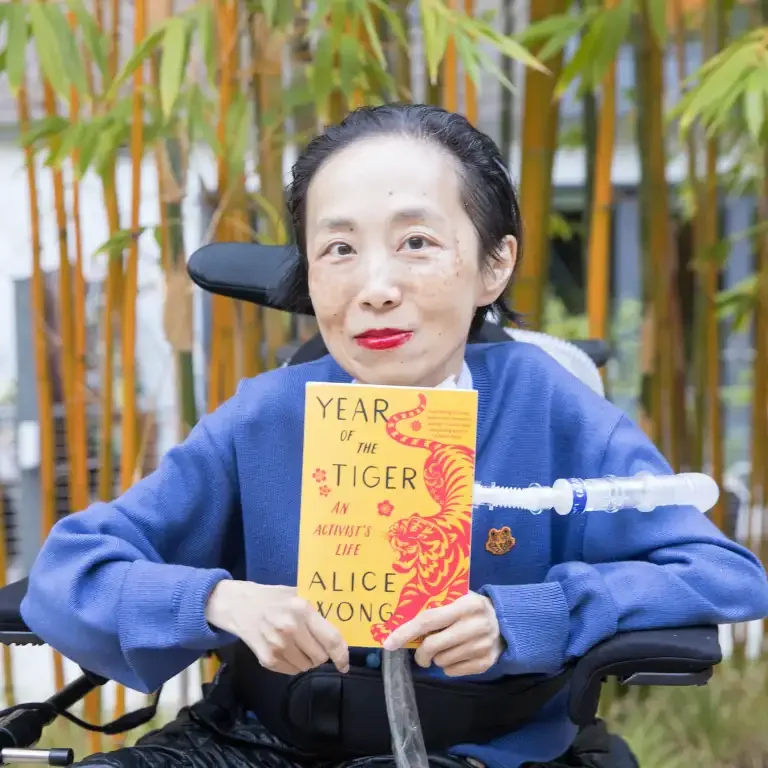
Photo of Alice Wong, an Asian American disabled woman in a power chair, against a background of bamboo trees. She is wearing a blue cardigan and sitting in a power chair. She is holding a copy of her memoir, Year of the Tiger, a paperback in yellow and red with a fierce tiger on it designed by Madeline Partner. She is wearing a bold red lip color and a trach at her neck. Photo credit: Eddie Hernandez Photography, via the DisabilityVisibilityProject.org media kit.
Alice grew up in the Midwest with her family and moved to San Francisco for grad school and the Bay Area disability community in the late ‘90s. In this excerpt from Year of the Tiger, Alice writes a letter to Asian American disabled women and girls “and future generations who still feel alone and unsure of their place in the world.”
“On radio, I want to hear people who lisp, stutter, make noises when they talk, use computer-generated speech, communicate, enunciate, and pronounce differently.”
In a May 2016 blog post for Transom, Alice explores options and access for people who communicate visually or non-verbally to contribute to oral history projects (such as with D.V.P. and StoryCorps) and radio. She writes about the story of her own voice and adjusting to using a Bi-Pap machine and becoming “Darth Vader”:
A big part of my identity, ego, and self-image is centered on my voice and writing. I had to confront my discomfort and accept my new sound and body that has become increasingly cyborg-like as time goes on. To paraphrase a beloved poem in the disability community by Laura Hershey, a woman who also used a Bi-Pap, I continually work on regaining a sense of pride by practicing.
Read the full blog post on Transom, which includes a recording of Alice reciting Laura Hershey’s poem “You Get Proud by Practicing.” Then, check out the first story Alice produced - “Choreography of Care,” on the complexities of care giving and receiving: podcast episode + transcript.
“I dream of a day when I can just be and it would be enough. I wish for all disabled people the choice of becoming an activist rather than being forced to as a means of survival.”
In a June 2024 live online conversation with Mia Mingus, Alice and Mia discuss the complexities and depths of disabled intimacy. Their wide-ranging conversation touches on solidarity, disabled heartbreak, activism, community care, death, joy, and more. Alice shares how a serious hospitalization in 2022 deepened her own understanding of disabled intimacy and about her healing and adjustment to a “radically Cyborg body,” including becoming a non-speaking person and using a speech-to-text app to speak. They discuss Alice’s motivations for editing the anthology Disabled Intimacy: Essays on Love, Care, and Desire, and how working on this book in collaboration with disabled writers was a part of her healing process.
Related:
In her opening remarks in the conversation with Mia linked above, Alice said: “I am in solidarity with the people of Palestine who are fighting for their homeland and their right to exist.” This is a blog post from October 2025 by Jane Shi, Leah Lakshmi Piepzna-Samarasinha, and Alice, on organizing crips for eSims for Gaza.
Alice shares more about her politicization and becoming an activist in a 2018 episode of the Solidarity Is This podcast with Deepa Iyer.
“As disabled oracles, we continue to build and create on the knowledge and dreams of our ancestors. They left their mark on the planet as will we. After we’re long gone, we will show up in other ways. Someone will see and discover us and we’ll be speaking with them from the past.”
In August 2020, as part of a project called Assembly for the Future, Alice gave a talk from the year 2029. One of the purposes of that project was to collectively imagine our futures - you can read the script of her talk at D.V.P. and watch Alice giving the talk here (scroll to the section that reads “AFTF online The Last Disabled Oracle”).
Practicing Solidarity, Building Capacity
At the Building Movement Project and Solidarity Is, we think of solidarity as a set of practices grounded in six core principles: Centering, Connections, Commonalities, Co-conspiratorship, Co-liberation and Capacity. While putting together this syllabus, and taking the time to sit with Alice’s words, the principle of capacity kept coming up for us. In the Solidarity Is Practice Guide, we wrote that “centering our capacity invites us to re-evaluate how we structure our movement-building efforts and campaigns, urging a move away from glorifying overwork and self-sacrifice towards practices that honor care, sustainability, and healing as revolutionary acts.”
What does capacity look like in practice? Alice’s work brings this down to earth. The quotes in this syllabus affirm, over and over again, how capacity is not just about what individuals can hold, but what we can hold collectively. Building capacity is not just about developing infrastructure to “get our work done,” but acknowledging how care, joy, access, and honesty actually expand what is possible in our work.
After experiencing a series of medical crises in June 2022, Alice shared her learnings about being reliant on a caregiver. She also pushed us to imagine the care infrastructure we deserve:
“I wrote about the future of care infrastructure in my memoir. They are not unfeasible dreams. Change comes from wild imaginations of what is possible. Here is a short excerpt:
In the future, care infrastructure will be …
one that treats care as a normal part of the human lifespan and not a failure or weakness to need help
one led and designed by disabled people and others who need or provide care
one that is free, publicly funded, and not means tested or linked to employment
one that puts a primacy on self-direction of the individual, bodily autonomy and dignity of risk rather than a formulaic, medicalized training that pathologizes disabled, older and chronically ill people”
There is something profound in Alice’s use of the word oracle; the struggle is long-term, and while so much of our capacity is passed down to us by those who came before, we are also actively building it—both for ourselves and those who will come after us.
As we close out this Solidarity Syllabus, we share a few practice invitations from Alice’s work:
In a speech for the Autistic Self Advocacy Network Gala in 2019, Alice said, “It took me a long time to identify as an activist because there are so many ableist BS ideas of what activism looks like.” She also encouraged us to answer this question together: “How do we expand the ideas of who gets to be an activist and what activism looks like?”
Consider the “Places to Start” suggestions in the #AccessIsLove resource created by Sandy Ho, Mia Mingus, and Alice Wong. How might you or your group expand what access means and looks like in the work that you do?
Alice told us that “Change comes from wild imaginations of what is possible.” What might the future of care infrastructure look like for people who provide and rely on care?
On November 14, 2025, Alice Wong became an ancestor. In her own words, she told us:
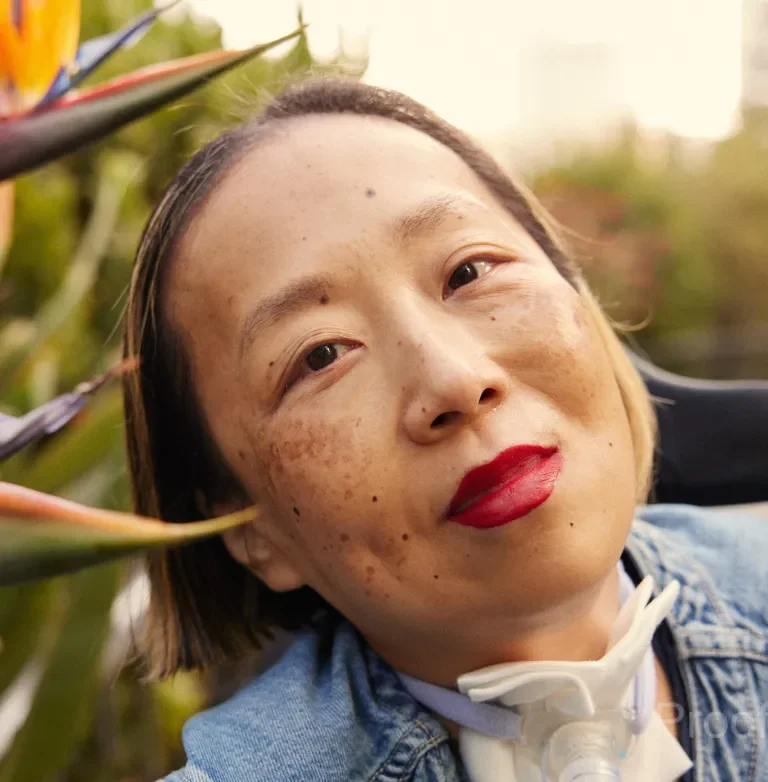
Alice Wong, an Asian American disabled woman with a tracheostomy at her neck. She is wearing a bright red lip color and a denim shirt. She is smiling with her head tilted toward some bird of paradise plants. Photo credit: María del Río, via the DisabilityVisibilityProject.org media kit.
Hi everyone, it looks like I ran out of time. I have so many dreams that I wanted to fulfill and plans to create new stories for you. There are a few in progress that might come to fruition in a few years if things work out. I did not ever imagine I would live to this age and end up a writer, editor, activist, and more. As a kid riddled with insecurity and internalized ableism, I could not see a path forward. It was thanks to friendships and some great teachers who believed in me that I was able to fight my way out of miserable situations into a place where I finally felt comfortable in my skin. We need more stories about us and our culture. You all, we all, deserve everything and more in such a hostile, ableist environment. Our wisdom is incisive and unflinching. I'm honored to be your ancestor and believe disabled oracles like us will light the way to the future. Don't let the bastards grind you down. I love you all.
About the Solidarity Syllabus blog series
Each syllabus is an invitation to slow down and visit (or re-visit) movement stories, with a few resources and reflection questions to get you started. Unlike a traditional syllabus, there are no due dates or grades here - just a chance to spend some time with movement lessons, elders, ancestors, art, and stories that may offer wisdom and grounding in these uncertain times.
When everything feels urgent, devoting energy to studying movement lessons may not seem like a priority. And yet, choosing to spend 10 minutes with a poem or 20 minutes once a week to work through an essay or book (perhaps with a friend or colleague - virtually or in person or even via voice notes and text messages) can be a sustainable way to deepen our political education. Practicing transformative solidarity requires us to move together, and continuing to develop our individual and collective political analyses - alongside the ongoing work of building relationships and organizing - can make our solidarity practice more possible and more durable. Find previous installments from this blog series here.