
Solidarity Syllabus: Indigenous Peoples, Rematriation, and Resisting AI Data Centers
For this Solidarity Syllabus, we are learning alongside Indigenous organizers, leaders, and communities whose work offers important solidarity lessons and invitations for how we might understand land, water, sovereignty, and resistance to data centers.
Indigenous Peoples Day is observed on October 12 this year. The perspectives shared here are a reminder that this observance is not just about acknowledging the past; it is a call for solidarity with those Indigenous organizers, leaders, and neighbors actively shaping the present and future.
Solidarity beyond land acknowledgements
The Native Governance Center describes Indigenous land acknowledgements as ”an effort to recognize the Indigenous past, present, and future of a particular location and to understand our own place within that relationship. Usually, land acknowledgments take the form of written and/or verbal statements. It’s becoming more and more common to see land acknowledgments delivered at conferences, community gatherings, places of worship, concerts and festivals, etc.”
In a recent op-ed for the New York Times, Reid Walker (a citizen of the Mandan, Hidatsa and Arikara Nation) wrote about the shortfalls of land acknowledgements.
As noted by both the Native Governance Center and Reid Walker, land acknowledgements frequently lack calls to action and next steps. Walker writes that all too often, “A ritual meant to recognize dispossession becomes a form of reassurance instead. History is named and then absorbed.” Walker continues: “Because the ritual still treats land as something that can be owned, it names the theft while leaving the idea of ownership untouched. Indigenous relationships to land were not about possession or title. They were about reciprocity, care, and responsibility.”
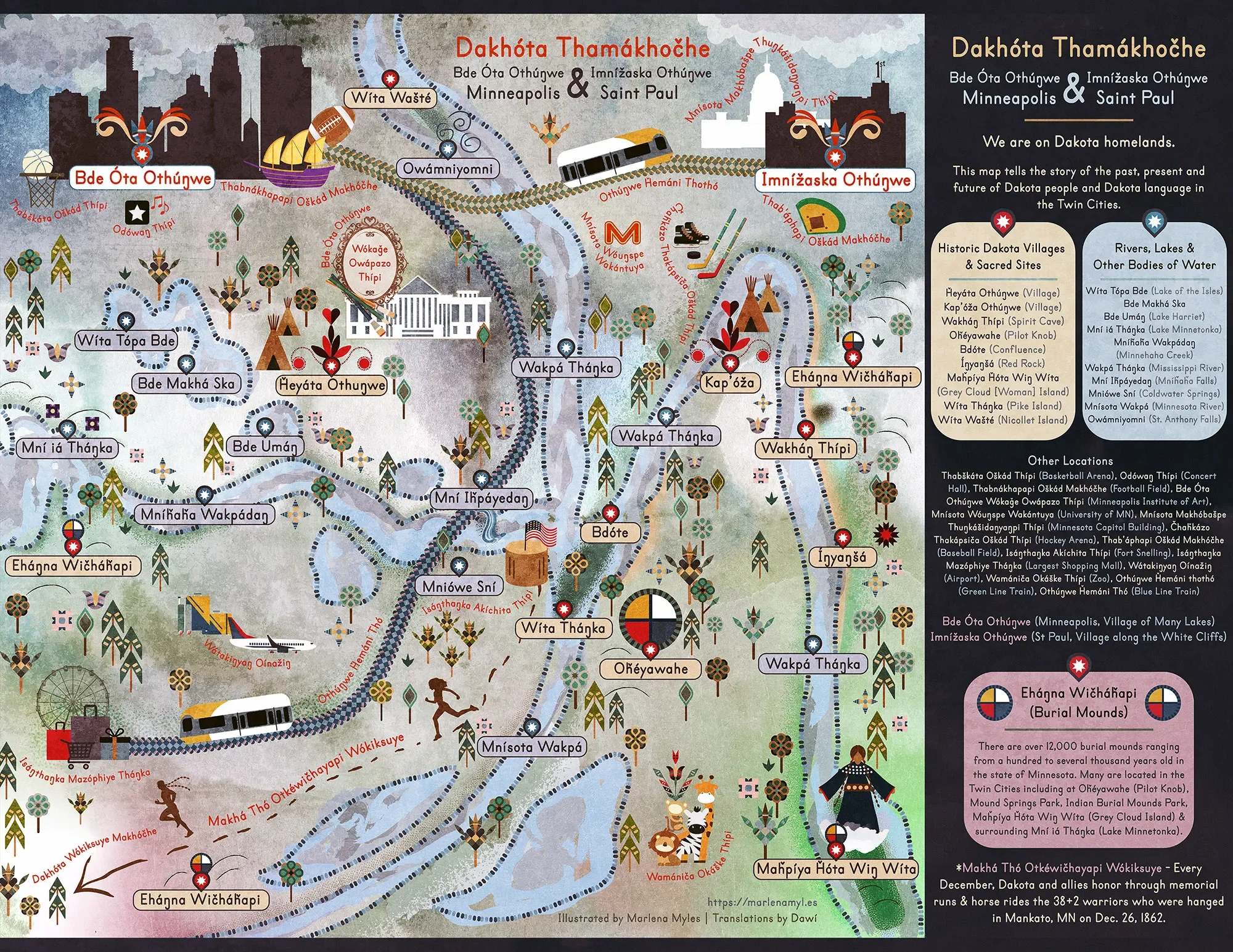
A map teaching about the Dakota past and present of Minneapolis & Saint Paul. Translations by Dawí Westerman (Huhá Máza); illustrated by Marlena Myles (Spirit Lake Dakota, Mohegan, Muscogee). Learn more at Marlena Myles’ website.
For non-Native folks in the U.S., what might solidarity with Indigenous communities look like beyond land acknowledgements? In their Beyond Land Acknowledgements guide, the Native Governance Center suggests: “Instead of spending time on a land acknowledgment statement, we recommend creating an action plan highlighting the concrete steps you plan to take to support Indigenous communities into the future.” The guide provides a number of reflection prompts and examples, particularly for individuals, to get started.
At the Building Movement Project, we understand transformative solidarity as a process, one that includes the practice of centering. When we practice centering, we listen, validate, and follow the lead of those closest to the experiences of inequity and injustice in developing campaign demands and systemic solutions. With this in mind, this Solidarity Syllabus centers and uplifts stories of Indigenous organizing and activism as well as Indigenous relationships to land that are rooted in reciprocity, care, and responsibility.
On rematriation
The term “rematriation” is often used to describe the work of Indigenous land return. The O’ga P’ogeh Land Tax project explains that “Rematriation is the woman-led returning to and reclamation of land, lifeways, language, seeds, and cultural artifacts supporting the sovereignty of Indigenous peoples and places. Rematriation invests in a future based on reciprocal relations to the land and all beings, and in opposition to patriarchal systems, moving from a society focused on individual ownership to one of collective care, safety, and liberation.”
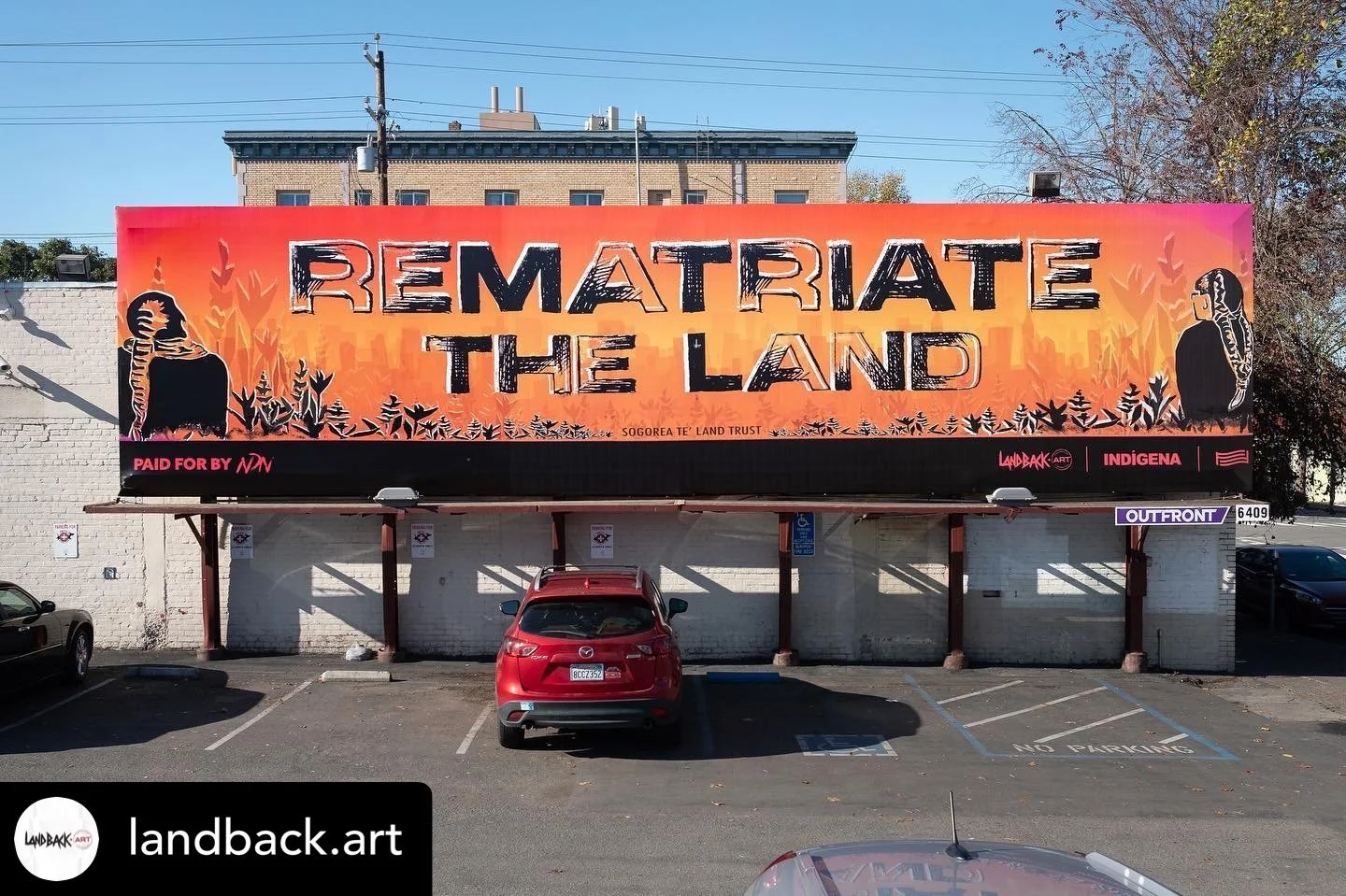
A billboard by Corrina Gould (@corrina_gould) and Inés Ixierda (@ines_ixierda) installed in 2021 in Berkeley, CA as part of @landback.art, a collective effort powered by @ndncollective @forfreedoms and @indigena to uplift Indigenous voices and broaden support for the #LANDBACK Movement. Photo by @singsinthetimber via @landback.art on Instagram.
For Cultural Survival, Dr. Crystal Cavalier-Keck (Occaneechi Band of the Saponi Nation) founder and Executive Director of 7 Directions of Service, writes about rematriation as it connects to land, ceremony, and Indigenous leadership:
Rematriation is often linked to the “Land Back” movement, but it goes deeper than land return alone. Land Back is a critical demand for justice, but rematriation adds the spiritual, ceremonial, and gendered dimensions that reflect how we relate to land. It asks: Who will steward this land? Who will sing for it, pray with it, raise children on it? In many nations, that responsibility belongs first to women—life-givers, knowledge keepers, water protectors. Colonization displaced not only our people, but also the roles we held within our societies. Rematriation re-centers Indigenous women’s leadership in theory, ceremony, governance, and land stewardship. You cannot restore the land without restoring the systems that once protected it, and grandmothers guided those systems.
To begin learning more (or to deepen learning) about rematriation, Speaking, Weaving, Passing On: Rematriation in Practice is a beautiful recap and reflection from the 2025 Ancestral Knowledges: My Grandmother Is My School program.
Rematriation, AI Data Centers, and Environmental Justice
“Who will steward this land?” is not a metaphorical question. In rural North Carolina, for example, it is a timely and pressing one with very real consequences for the peoples and communities along the Dan River in Stokes County.
The rapid growth of AI requires hyperscale data centers - massive physical facilities to house the machines necessary to power artificial intelligence. These data centers require large tracts of land - meaning that major tech companies often target rural areas and tribal nations for data center construction, such as with Stokes County, North Carolina. The region is the ancestral homeland of the Indigenous Saura people, and descendents of formerly enslaved families also call the region home. In January 2026, despite strong opposition from the community, the Stokes County Board of Commissioners approved a measure that rezones nearly 1,800 acres along the Dan River and clears the way for Project Delta, a massive data center development. As of March 2026, community groups and residents are suing to stop the zoning change in an effort to preserve their community and access to clean air and water.
“Rematriation is often linked to the ‘Land Back’ movement, but it goes deeper than land return alone. Land Back is a critical demand for justice, but rematriation adds the spiritual, ceremonial, and gendered dimensions that reflect how we relate to land. ”
7 Directions of Service are among the groups represented in the lawsuit, and in response to the proposed data center along the Dan River, 7 Directions ED Cavalier-Keck shared with the Southern Environmental Law Center that “Our organization was founded to protect sacred places and defend the lands and waters that hold our ancestors’ stories. Data center development that threatens burial grounds, cultural sites, and the river itself is not just an environmental issue — it is a threat to Indigenous heritage and the responsibility we carry to care for these lands for future generations.”
The resistance to Project Delta in North Carolina is just one example of local organizing against the proliferation of data centers. Honor the Earth, an Indigenous-led organization, recently launched the No Data Center Coalition, with the understanding that “data centers are the next frontline of water protection.”
Data centers require massive amounts of water to keep the servers cool (a single facility can use millions of gallons of water on a hot day, according to this BBC article). But a new report from Ceres reveals that the water used for power generation to meet data centers’ massive energy needs has an even greater impact than the amount of water used to cool their servers. The report examined water centers across the seven states that host about half of all U.S. data centers: Virginia, Texas, California, Illinois, Georgia, Ohio, and Arizona. The data centers in these states depend on about 3.4 trillion gallons of freshwater annually for electricity, around 12 times the annual water use of Los Angeles, Phoenix, and Washington D.C., combined. Additionally, the study found that most electricity is generated by power plants located in areas facing water stress or drought (or both).
In an interview with Amy Goodman for Democracy Now!, Honor the Earth Executive Director Krystal Two Bulls (Oglala Lakota and Northern Cheyenne) spoke about how tech companies targeting Indigenous lands for the AI boom is a continuation of a long pattern in history:
Indian Country is always a target for extractive industry. And what history has taught us is that anytime outside industry comes into Indian Country and has all these big, you know, promises of jobs and economic development and language revitalization and all of these things, that it tends to not work out for us. We are never the ones that actually truly benefit from that, and we’re always the one that ends up having to sacrifice our relationship to land, air, water, our communities and our nonhuman relatives, as well.
Two Bulls also describes how Honor the Earth uses their organizer and activist networks to build relationships with different Native nations. In Oklahoma, for example, the Honor the Earth team is on the ground. Local activists and organizers are “able to build multiracial coalitions with folks in agriculture, ranchers, land owners, etc., and they’ve built these coalitions, and they are working with local communities and local municipalities and local tribes to push back and put in some kind of buffer in protections for our communities.”
In this way, information about the true impact of hyperscale data centers can be shared and demystified, so local Indigenous communities can make their own informed decisions when companies like Amazon and Meta approach them with proposals. Learn more about Honor the Earth’s organizing approach in Oklahoma in their impact report.
Closing considerations
In our Solidarity Is Practice Guide, we write that co-liberation is about “challenging and unlearning the oppressive systems within and around us,” something that is “not a one-time act but a continuous process of reflection, accountability, and action.”
Especially for non-Indigenous individuals, while “know whose land you're on” has become a familiar call in movement circles and in some educational and cultural institutions, we can challenge ourselves to expand this to “know who is still here, what they’re working on, and how we can move in solidarity with them.” In that spirit:
In LandBack for the People, a column with Nonprofit Quarterly, NDN Collective builds on their podcast of the same name, sharing stories from Turtle Island and beyond about Indigenous people organizing in community, advocating for social justice, and fighting for the return of Indigenous lands.
The Beyond Land Acknowledgements guide from Native Governance Center encourages taking the time to research and create a personal action plan, from a self-assessment to outlining concrete steps and more.
The O’ga P’ogeh Land Tax shares a list of ongoing land tax projects. In the spirit of co-conspiratorship (moving from acknowledging or rejecting our privileges to actively using our resources to redistribute power), a land tax, whether paid by an individual or organization, can be one tool for turning values into action.
Resource Generation maintains a Land Reparations & Indigenous Solidarity Toolkit featuring best practices, case studies, and guiding questions.
This article explores the legal roots of “Indian” and “Indian Country” in the U.S. Constitution, treaties, and federal law. (Minnesota Public Radio, October 2026).
Resources for Philanthropic Institutions to Support Solidarity Practice
Language and Learning resource for Non-Indigenous People (designed for use of external partner orgs) via Native Americans in Philanthropy
indigenous centered - Improving Equity and Accountability for Native American Communities with Community Foundations via Native Americans in Philanthropy
Overlooked (Part Two) – Foundation Support for Native American Leaders and Communities via The Center for Effective Philanthropy
Building Right Relationship: A Philanthropic Call to Support Indigenous Land Sovereignty Through Shuumi - Asset Funders Network - A joint statement from the Bay Area Asset Funders Network (AFN), San Francisco Foundation (SFF), and East Bay Community Foundation (EBCF) on the 10th Anniversary of the Shuumi Land Tax.
Funding Map - See how funders are investing in Native communities and organizations based on their grantmaking data. A joint project of Native Americans in Philanthropy and Candid.
Funder Engagement Framework via the Right Relations Collaborative
Solidarity Is This podcast - Funding Movements Differently (2022). Host Deepa Iyer is in conversation with Cúagilákv (Jess Housty) and Kim Hardy to uplift lessons from the Right Relations Collaborative, a philanthropic effort that centers the Indigenous Aunties Council.