
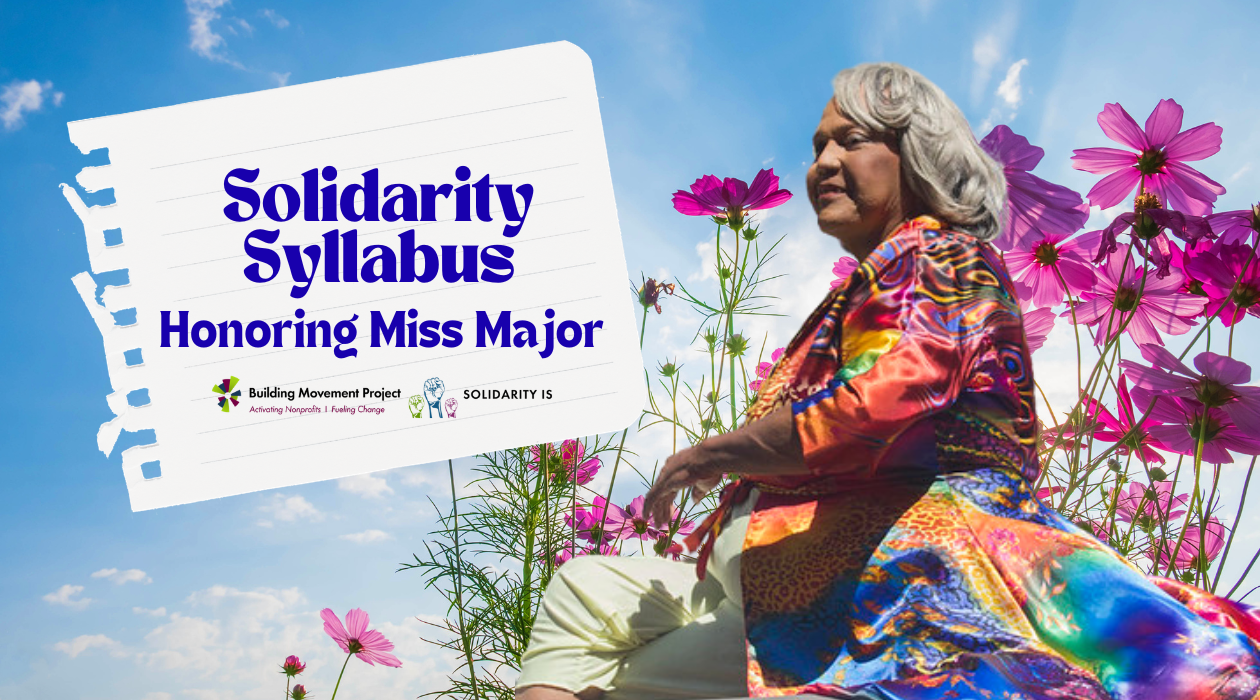
Digital collage featuring a photo of Miss Major at the San Francisco Pride Parade in 2014. She is wearing a long satin jacket with a bright, multicolored pattern of swirls and cheetah print, and her silver hair is styled in a bob with the ends waved. The collage background is a photo of bright pink wildflowers against a blue sky with white clouds.
For this Solidarity Syllabus, we uplift the life and legacy of Miss Major Griffin-Gracy, a Black trans activist who fought for over fifty years for her trans/gender nonconforming community.
Miss Major was a veteran of the infamous Stonewall Riots, a former sex worker, and a survivor of Dannemora Prison and Bellevue psychiatric hospital. She also founded and led House of gg (The Griffin-Gracy Educational and Historical Center), a sanctuary in Little Rock, Arkansas, which “creates safe and transformative spaces where members of our community can heal—physically, mentally, emotionally, and spiritually—from the trauma arising from generations of transphobia, racism, sexism, poverty, ableism and violence, and nurture them into tomorrow’s leaders.”
Miss Major became an ancestor on October 13, 2025. She was in the comfort of her home, surrounded by her loved ones. In the words of House of gg:
Miss Major–known as ‘Mama’ to many–was a Black, trans activist who fought for more than fifty years for trans, gender nonconforming, and LGB community– especially for Black trans women, trans women of color and those who have survived incarceration and police brutality. Major’s fierce commitment and intersectional approach to justice brought her to care directly for people with HIV/AIDS in New York in the early 1980s, and later to drive San Francisco’s first mobile needle exchange. As director of the TGI Justice Project, she’d return to prisons as a mentor to her ‘gurls’ inside. In 2019, she would be powerfully guided by spirit and her vision in search of a family gathering property. House of gg was born out of her dream to build a center that would empower, heal and be a safe haven for Black trans people and movement leaders in the Southern US–a space for our community to take a break, swim, enjoy good food, laugh, listen to music, watch movies, and recharge for the ongoing fight for our lives.
Miss Major’s life offers countless examples of transformative solidarity in practice: building structures of care outside systems that failed her people, nurturing leaders, creating spaces for healing, and refusing to separate liberation from joy.
At the Building Movement Project and Solidarity Is, we think of transformative solidarity as a set of intentional and consistent practices that deepen relationships, transform ourselves and our institutions, and strengthen the infrastructure connecting our organizations and movements over time. Transformative solidarity builds our collective capacity to respond to changing conditions - and to shape the policies, culture, and systems needed for liberation.
As we put this syllabus together, it was hard to decide what to focus on as Miss Major’s legacy of fierce activism and organizing was so rich and deep. Here are just a few solidarity stories - examples of nurturing the spaces and capacity for healing and joy; working together towards co-liberation and our mutual freedom and shared power - that we noticed.
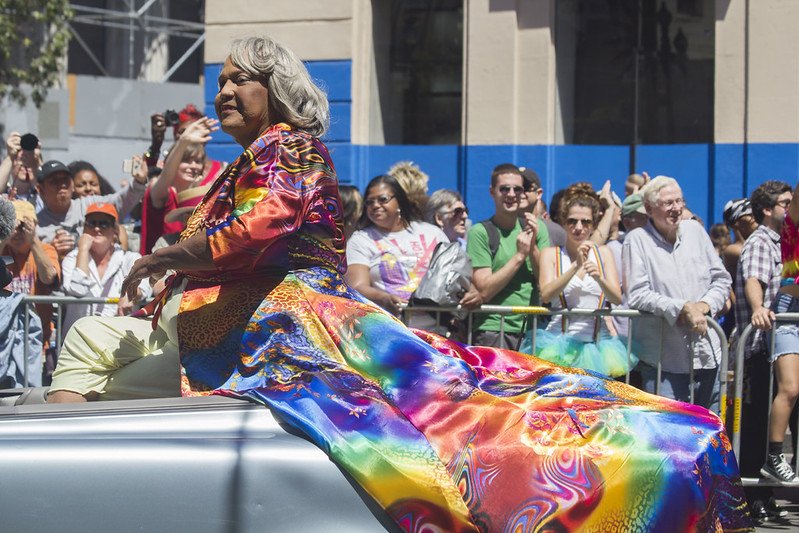
Miss Major at the Gay Pride Parade in San Francisco, 2014. Photo by Quinn Daedal on Flickr.
On organizing and building the world we want
Miss Major was a builder. In recent years, abolitionist and transformative justice movements have often lifted up the idea that “we keep us safe.” What does this look like in practice? Keeping us safe means creating and experimenting with new models, systems, and structures to care for each other. For Autostraddle, Kayla Kumari Upadhyaya and Riese highlight some examples of how Miss Major had long been putting this idea into practice:
During the AIDS crisis of the 1980s, Miss Major’s Angels of Care organization sent a group of trans girls to care for dying gay men in the San Francisco bay area. “No one wanted to take care of those gay guys when they first got AIDS,” she told SF Weekly. “and a lot of my transgender women stepped up to the plate to do it.” She facilitated a mobile needle exchange and organized against an AIDS non-profit leader who tried to break up her drop-in center for trans sex workers.
…Miss Major built a life around seeing a problem and having the confidence and trust in her community to develop a solution outside of traditional systems of power and capital. When a sex worker friend was murdered and the police did nothing, she and a friend developed a system for the girls to track each other, recording license plates whenever anybody was picked up. When she saw children who needed homes, she took them in.
In reading about Miss Major’s legacy, we also noticed how land ownership and stewardship was part of her vision in creating more self-determination, liberation, and safety for trans people of color. For example, in a 2023 interview with Sam Levin at The Guardian, Miss Major reflected on her dream of creating House of gg, a welcoming sanctuary for trans folks to just rest and relax. “I’ve gotta make joy here, because it doesn’t exist in the normal world… When the girls come here, they don’t have to worry about anything. I’ve wanted this for so long, but I couldn’t figure out how. Who’s gonna let me own property? But I finally have it. It’s in a red state, but I don’t care. It can be whatever color, I’m still gonna be here.”
“I want my memory to live on in the hearts of the grassroots.”
In December 2025, after her passing, Pax Ahimsa Gethen at Assigned Media spoke to Miss Major’s beloved community for some of their favorite memories:
Janetta Johnson, who was first daughter to Miss Major, recalled Major’s visit to San Francisco for the ribbon-cutting of the TGIJP center that now bears her name. “It was her vision to have Black trans ownership in San Francisco and with her mentorship and support we were able to make that happen!”, she said. “I am so proud that as a Black trans woman I was able to name a building owned by the Black trans community after my Black trans Mama!”
Perhaps Miss Major herself put it best when she said: “I know the world I would like to live in. It’s in my head, but I try my best to live it now.”
On joy and pleasure alongside the fight
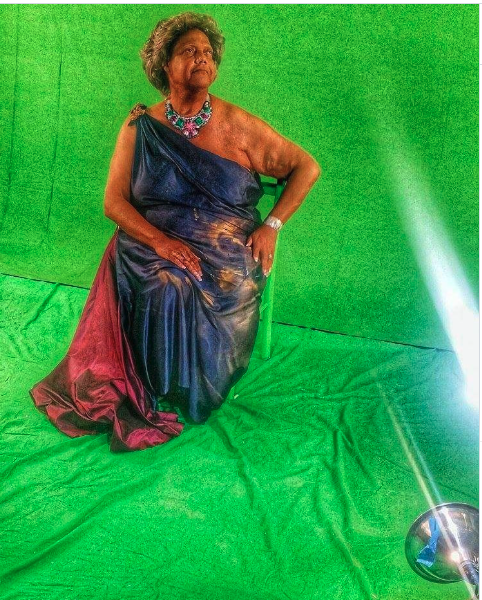
Miss Major in May 2017 / Credit: Miss Major’s IG
In reading about Miss Major’s life and work, we noticed examples of joy and pleasure scattered throughout the stories she told and the stories her community told about her. Tourmaline noted: “Major had a capacity to revel in really small, seemingly everyday things, whether it was the horror movie that was coming on cable, or she once talked about how luxurious a cool cup of water can feel.” In this 2012 piece, Jessica Stern writes about how Miss Major self-identified as a “‘glamour puss,’ a descriptor uniquely her own. ‘I like to have the right style. Paint the face, grab my heels, make sure my purse matches, and hit it. It’s Miss Major, spelled M-I-S-S.’”
And in this piece for Truthout published shortly after Miss Major passed on, Toshio Meronek and Eric A. Stanley share a story of a time that Miss Major literally knocked down a wall to make more space for trans gurls at the Tenderloin AIDS Resource Center in San Francisco in the 1990s. In between stories about Miss Major’s political organizing, we also learn about her love for sugar and See’s Candies fudge.
Meronek and Stanley note in the conclusion of their piece: “the way to honor Major is to keep hammering holes in the walls that confine us, and to expand the trans and queer spaces she built. Grief can transform into joyful rage by the reminder that Major is indeed, still fucking here.”
On everyday personal acts fueling activism
In the summer of 2023, Miss Major met with transgender community members and activists in Washington, D.C., “We have the nerve to drive the conversation … when we’re somewhere, we change that space forever,” she told them. “Just walk in and you change it, just by being there. And you will.” In The Personal Things, Miss Major shares a story about how she does exactly this by finding her own way to strike back, so that people “know I’m a transgender person, and love me for that.”
On mothering and family
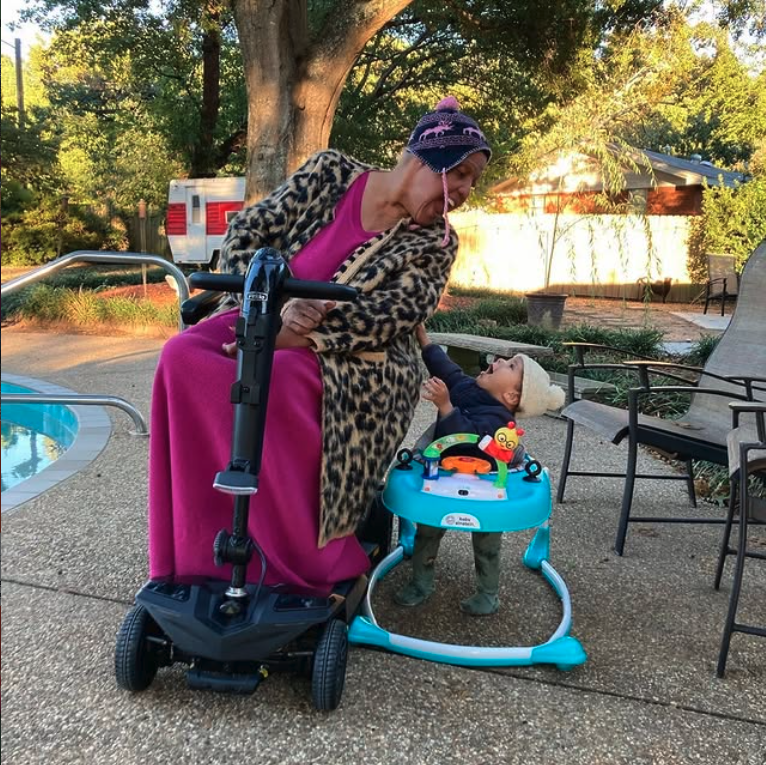
Mother’s Day, May 2022 / Credit: Miss Major’s IG
As noted in the statement by House of gg we shared at the opening of this solidarity syllabus, Miss Major was known as “Mama” to many. She is survived by her longtime partner, Beck Witt, and her three sons Asaiah, Christopher, and Jonathon, as well as many daughters and community members who were shaped by her mentorship and leadership and a Black elder and matriarch in the trans liberation movement.
Carter Cavazos, director of community partnerships at E3 Radio, spent time at House of gg in September of 2025, and told the Windy City Times: “A lot of people know Miss Major as an activist and think about her work at Stonewall. But the root of all of that is somebody who cared so deeply for her people, for her girls, for trans and nonbinary folks, that she was willing to do whatever it took to protect them. She loved so hard. She’s truly the mother of us all.”
In this piece at Them, Tre’vell Anderson spoke to several of Miss Major’s daughters about the family that she built. Artist and filmmaker Tourmaline said of Miss Major: “She really was not turning down the volume of her life for anyone. That, to me, is what it means to walk in her footsteps or be a daughter of Miss Major.”
And activist and organizer and TGI Justice executive director Janetta Johnson told Anderson: “It’s highly likely if you are one of her daughters, you're going to help other trans people. If you’re all for yourself and you ain't about helping other trans people, you are not her daughter, because she gives us marching orders to help and support community in any way.”
To close this Solidarity Syllabus, we invite you to consider:
Who are your people, blood or chosen? How do they keep you anchored in these volatile times? What do you have to offer them, that is a unique offering only you can make because of who you are and the relationships you hold?
In your communities - digital or physical - where do you see efforts to hammer down the walls that confine us and expand trans and queer spaces?
For organizational leaders - what spaces or skills are needed to make space for grief and joy as we do this work for the long-haul?
We leave you with these words from Miss Major for Broadly’s Trans Legends Oral History Project:
“If this world is going to get its act together, they have to support and put in the front to lead this revolution the people who are the most oppressed, which is my Black transgender community… We have a culture, we have a history, we have a reason to be here. We have a purpose. We’re entitled to be loved, and seek happiness, and share that with the people that we care about. Blood isn’t the only connection that we can have to one another.”
Learn More
Miss Major Speaks: Conversations with a Black Trans Revolutionary by Miss Major Griffin-Gracy and Toshio Meronek (Verso Books, 2023)
Major! - a 2015 documentary film about the life and campaigns of Miss Major
What Mama Major Taught Us - memories and calls to action from a few members of Miss Major’s community in this Assigned Media piece by Pax Ahimsa Gethen
About the Solidarity Syllabus blog series
Each syllabus is an invitation to slow down and visit (or re-visit) movement stories, with a few resources and reflection questions to get you started. Unlike a traditional syllabus, there are no due dates or grades here - just a chance to spend some time with movement lessons, elders, ancestors, art, and stories that may offer wisdom and grounding in these uncertain times.
When everything feels urgent, devoting energy to studying movement lessons may not seem like a priority. And yet, choosing to spend 10 minutes with a poem or 20 minutes once a week to work through an essay or book (perhaps with a friend or colleague - virtually or in person or even via voice notes and text messages) can be a sustainable way to deepen our political education. Practicing transformative solidarity requires us to move together, and continuing to develop our individual and collective political analyses - alongside the ongoing work of building relationships and organizing - can make our solidarity practice more possible and more durable. Find previous installments from this blog series here.